
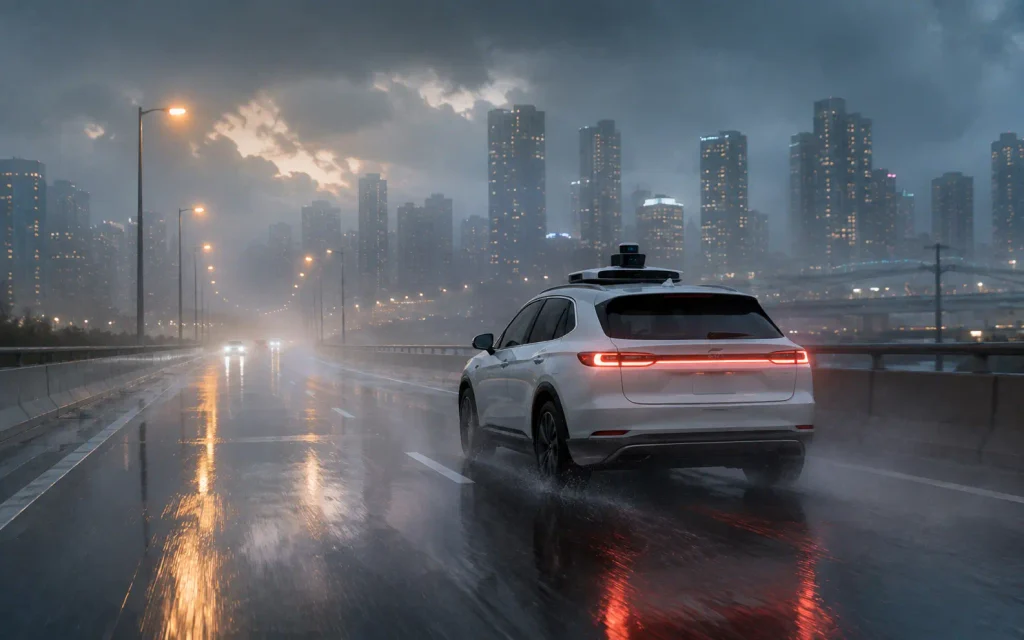
Bad weather is one of the biggest challenges for autonomous vehicles. Rain, fog, snow, and sun glare can affect cameras and LiDAR, obscure road markings, and reduce visibility. Radar is generally more reliable in poor visibility, but severe weather can still affect a vehicle’s overall perception.
Weather and climate data can improve autonomous-vehicle safety by helping driving systems anticipate hazardous conditions beyond the immediate range of onboard sensors. This additional environmental context can support earlier decisions about speed, following distance, and route selection.
Vision Tech Software develops real-time weather, climate, and environmental data solutions designed to support more weather-aware autonomous-vehicle systems. To learn more about climate-data solutions for autonomous vehicles, call Vision Tech Software at 718-421-2076.
Why Weather Is a Challenge for Self-Driving Cars
Bad weather makes it harder for self-driving cars to “see” the road clearly. Here’s how different weather types affect them:
- Heavy rain can confuse LiDAR and cause false readings.
- Fog can significantly reduce camera visibility and affect LiDAR performance, while radar generally remains more reliable in low-visibility conditions.
- Snow can cover lane markings, so cameras can’t see the road lines.
- Sun glare can confuse cameras trying to detect objects.
These problems happen often, not just once in a while. That’s why weather data is now a key part of how self-driving cars stay safe, not just an extra feature.
The Role of Real-Time Weather Data in AV Decision-Making
A static map may show the route, but it does not provide live information about weather or road-surface conditions. That’s why real-time weather data matters. It includes things like:
- Temperature
- Rain or snow
- How far the car can see
- Wind
- Road surface conditions
This live information helps the car’s system react early, before a problem happens. This is called environmental sensor data. Instead of only reacting to what’s right in front of it, a self-driving car with live weather updates can plan. It can slow down sooner, leave more space from the car ahead, or lower its speed before the road gets risky. When this is combined with road condition monitoring, the car gets a clearer picture not just of the weather, but of how that weather is affecting the road itself.
How Satellite and Climate Intelligence Enhance Safety
Vehicle sensors show what is happening nearby, while satellite intelligence and weather data help the system anticipate what may be ahead. When you combine satellite weather data with real-time sensors, self-driving cars can actually get ready for weather before it even arrives. For example:
- A storm heading toward a delivery route
- Flooding along a highway
- Icy roads that tend to happen in certain seasons
This kind of early warning is really useful for planning fleets. It’s not just about knowing what’s happening right now. Operators want to see what’s coming across their whole service area, so they can plan instead of scrambling at the last minute.
How Weather Data Supports Advanced Autonomous Vehicles
Advanced autonomous vehicles use cameras, LiDAR, radar, GPS, and maps to understand the road. Weather data adds more context by showing whether rain, fog, snow, or glare may be affecting these systems.
For example, if the camera suddenly ceases to be stable, real-time weather data could reveal that dense fog may be the reason. The vehicle may utilize this information to decrease its speed or increase the distance it follows or determine whether it’s appropriate to proceed.
This is particularly important for this is especially important for Level 4 vehicles. They can operate without human supervision; however, only under certain conditions. These limits are referred to as the Operational Design Domain (ODD) and could include the location and type of road, speed, weather, and type.
If severe weather moves the vehicle outside these safe operating conditions, it may need to slow down, change its route, or stop safely. Level 5 vehicles are designed to drive in all conditions that a human driver could reasonably handle, which makes this level much harder to achieve.
Real-World Applications
Weather and climate intelligence can support several autonomous-mobility applications:
- Robotaxis: Assessing whether routes remain suitable during storms or poor visibility
- Autonomous delivery vehicles: Identifying weather-related disruption and potential flooding
- Self-driving trucks: Considering developing storms and road conditions during route planning
- Fleet operators: Monitoring environmental conditions across an entire service area
In each application, weather intelligence provides additional context. It does not replace onboard sensors, safety controls, or proper system validation.
Benefits of Integrating Weather and Climate Data
Here’s what actually improves when weather and climate data is built into a self-driving system:
- Fewer safety issues caused by bad weather. The car needs less human help stepping in when conditions get tricky.
- Smarter speed and spacing decisions. The car slows down and keeps more distance when visibility gets poor.
- Better route planning. The car can steer around storms or flooding before they become a problem.
- Easier compliance. As regulators pay closer attention to how AVs perform in bad weather, this helps companies stay ahead.
- More trust from riders and businesses. People feel more confident in a self-driving car that handles all kinds of weather, not just sunny days.
At the end of the day, this isn’t just about avoiding problems. It’s about making self-driving cars something people can actually rely on, no matter the season or location.
How Vision Tech Software Powers Weather-Aware AV Systems
Based in New York, Vision Tech Software has more than seven years of experience in AI, satellite imagery, and data integration. The company supports automotive and autonomous-mobility partners across global markets. Its key capabilities include:
- Live weather insights: Data about rain, snow, fog, wind, and visibility.
- Climate-risk analysis: Insights into flooding, extreme heat, and severe weather.
- Satellite intelligence: A wider view of environmental conditions along a route.
- AI-powered analysis: Data from multiple sources combined to identify potential hazards.
- Route-planning support: Current and predicted conditions that help systems assess suitable routes.
- Sensor support: Environmental information that complements cameras, radar, LiDAR, and digital maps.
Vision Tech Software provides additional environmental context that can help developers build more weather-aware autonomous vehicles. Each solution still requires proper testing and validation before being used in real-world driving conditions.
Build Smarter, Weather-Aware Autonomous Vehicle Systems
Give your autonomous-driving system a better understanding of changing weather and environmental conditions. Vision Tech Software can help you integrate real-time weather, climate and satellite data into your existing platform. Discuss your data requirements and autonomous-mobility project with our team.
Frequently Asked Questions
How do self-driving cars handle fog or snow?
They rely on a combination of sensor fusion and environmental sensor data cross-referencing degraded camera or LiDAR input against known weather conditions to adjust speed, following distance, and route decisions accordingly.
What weather conditions affect autonomous vehicles most?
Heavy rain, dense fog, snow, and low-sun glare tend to cause the most disruption, since each interferes differently with LiDAR, radar, or camera-based perception systems.
What is climate risk data in AV systems?
Climate risk data refers to satellite-derived intelligence on developing or seasonal weather patterns such as flood zones, storm paths, or ice-prone corridors used to inform AV routing and fleet planning ahead of time, not just in-the-moment sensor readings.
Can weather data fully eliminate AV safety risks in bad weather?
No single data source eliminates risk, but integrating real-time weather data with sensor fusion significantly reduces the uncertainty that adverse conditions introduce, making Level 4/5 autonomy more reliable across a wider range of environments.